The need for innovative solutions to complex problems has driven my work at the intersection of science, policy, and media.
I have created content and provided strategic advice for platforms including Science Friday and The Delve Podcast. I have even interviewed a space-bound NASA astronaut! More recently, I have produced my own longform video series about fired federal workers and others called the Defunded Science Series.
As a policy and strategic communications professional, I have contributed my public relations expertise to drive actions to make health care safer with Patients for Patient Safety.
Read about this work and more below. (For samples of my work as a science copywriter, check out my services page or visit my science communications company, Fancy Comma.)
If you’re interested in my scientist-to-science writer origin story, you can find it at The Xylom. I also write often at the Fancy Comma, LLC blog. I still research neuroscience, including neuroscience of journalism, independently as well – here’s my still-active Google Scholar.
Skip to a particular section of my portfolio:
Scientific research:
– Studying stress and addiction’s effects on the brain
Policy work:
– Making health care safer
Multimedia and social media works:
– Producing in-depth podcasts
– Captioning a video documentary about MIT
– Interviewing experts on the Fancy Comma YouTube channel
– Live-tweeting the Artemis I launch with NASA and interviewing an astronaut
– Producing the “Defunded Science Series” in both short-form and long-form video versions
Educational projects:
– Creating K-12 neuroscience activities for Science Friday
– Aspen Digital “Interpreting AI in the News” high school media literacy lesson plan
Written journalism, books, and peer-reviewed works:
Books
Peer-Reviewed Works
Local Journalism
Articles
– Science Communication
– Health
– Science and Technology
– Arts and Culture
Science Research
Studying stress and addiction’s effect on the brain
Having earned a BS from MIT in brain and cognitive sciences and an MS in neuroscience from Georgetown University, I have been pursuing neuroscience research in various forms since 2003, when I worked on my first project looking at face processing as an MIT student. I left academic science in 2014 after graduating with my Master’s and volunteering in various research labs afterwards while becoming a freelance writer and policy expert, though I now research neuroscience independently. Check out my scientific articles spanning decades of research in various roles over at Google Scholar.
After undergraduate and before graduate school, I worked at the Massachusetts General Hospital, investigating the effect of alcohol on cognitive control, as well as helping with studies of alcoholism’s effects on brain structure. You can read more about that work over at my ORCiD bio.
As a PhD candidate at Georgetown, I worked on two projects examining the neural bases of addiction, stress, and trauma: 1) identifying brain imaging biomarkers of Post-Traumatic Stress Disorder (see my citable preprint article as well as posters here and here) and 2) links between adolescent brain development and decision-making. In 2024, I co-authored an article summarizing years of research and scholarly thought into the neural correlates of alcoholism in adolescents at with varying risk profiles for developing alcohol use disorder. You can download all of my research papers on Google Scholar, ResearchGate, or on this page.
Currently, as an independent neuroscientist and Seeds of Science Research Fellow, I seek to study neuroscience as applied in real-world settings. Read my Seeds of Science bio here!
Check out my peer-reviewed publications as an independent scientist on this page alongside my multimedia science communication work on this page, or follow me on ResearchGate.
Policy Work
Making health care safer
I worked with Patients for Patient Safety, a nonprofit affiliated with the World Health Organization, to help enact federal actions to reduce preventable harm and death that occurs in the healthcare setting, as the go-to for public relations communications from March to September 2024. As part of the Patients For Patient Safety planning committee for World Patient Safety Day 2024, I helped plan events in Washington, DC on September 15-18, 2024, which included both a March on Washington for Patient Safety and Capitol Hill Day visits.
I developed and polished White House- and Congress-facing communications to effectively communicate patient safety issues and needed policy solutions to government officials. I published a vlog (video diary) about my activities that week in Washington, DC, going to offices of my lawmakers to advocate for patient safety. This work, which involved working with stakeholders working in hospitals as well as with government agencies such as the Center for Medicare and Medicaid Services, led to the White House announcing actions to improve patient safety as part of the PFPS World Patient Safety Day 2024 events.
Podcast/Radio/Video:
Producing in-depth podcasts
I kicked off my production internship with The Delve podcast by selecting the podcast excerpts for the Season 7 podcast trailer, which you can listen to here.
I next pitched, researched, wrote the intro monologue for, and helped produce a podcast called “The Mental Impact of War Reporting.” The February 9, 2024 podcast episode features a clip from an interview I conducted for my science communications company, Fancy Comma!
Listen to the episode below (warning: contains descriptions of violence) and read this take from Soldiers for the Cause, a veterans’ anti-war blog:
I also researched and wrote the intro monologue for a two-part Delve episode called “Haiti: Beyond the Brink” talking about the dire situation in the Caribbean nation with Macollvie Neal, editor of the Brooklyn-based Haitian Times. Part 1 was released on April 12, 2024, and Part 2 aired on April 16, 2024.
Listen to Part 1 here:
Listen to Part 2 here:
I was also interviewed, along with the rest of the production crew, as part of the “Behind the Scenes: The Production Team” episode on May 17, 2024.
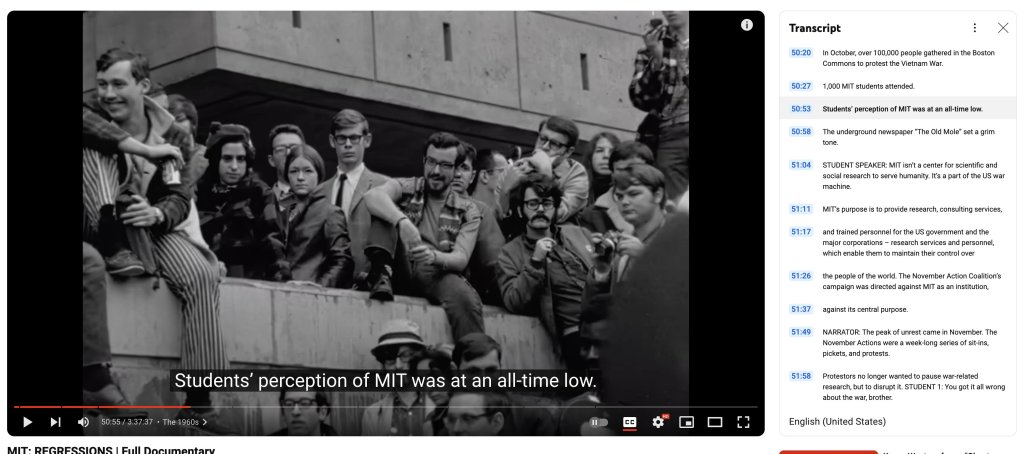
Captioning MIT:REGRESSIONS, a documentary about MIT

I led a group of MIT community members in captioning the student-produced documentary about the history of MIT from the World War II era onward, called MIT: Regressions, which you can watch here. Given that the documentary was over 3.5 hours long, this was a massive undertaking.
Interviewing experts on the Fancy Comma YouTube channel
Check out the Fancy Comma YouTube, where I often conduct interviews with experts in various scientific, creative, and policy domains.
Live-tweeting the Artemis I launch with NASA and interviewing an astronaut
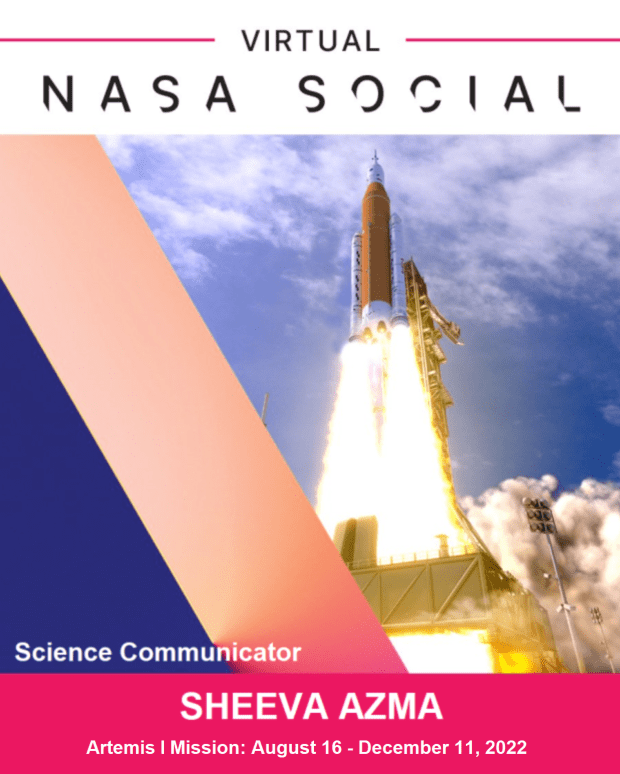
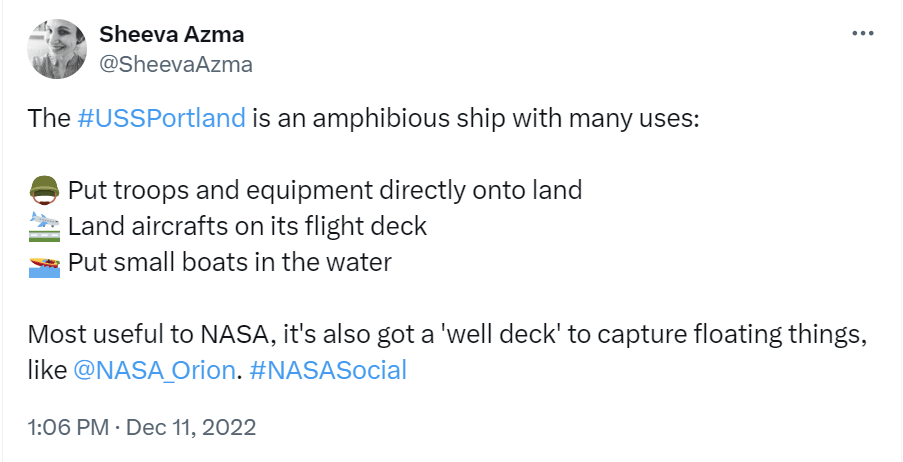
As part of the virtual #NASASocial team, I live-tweeted NASA’s Artemis I launch, including its many setbacks which caused delays (hey, space is hard!). You can find all my tweets here. Below is one of my favorite tweets I wrote about the USS Portland, a vessel used to collect the Orion capsule following its long space voyage.
On March 19, 2025, I interviewed Dr. Jonny Kim, flight engineer for Expedition 73. Watch my interview on NASA Video or read my blog about it here.
Producing the “Defunded Science Series” in both short-form and long-form versions
In mid-2025, I began interviewing people who were fired from the federal workforce, scientists whose grants were defunded, and others impacted by government funding cuts. I served as sole producer for these interviews, which I titled the “Defunded Science Series.” They are available in long-form content on YouTube and as short-form content on Instagram.
Educational Works
Creating educational neuroscience content for Science Friday
I served as developmental editor for Science Friday’s “Hack Your Brain,” a free neuroscience escape room event to help middle schoolers learn more about their own brains. This work was recognized by Science Friday on their Best of 2024 list as well as by the White House! Check out the WH fact sheet here.
I was hired as a “developmental editor and fact-checker,” but in practice, especially since I was involved in developing the activities at their earliest stages, I played a bit of a consultant role. I applied what I learned from developing my own free SciComm curriculum to help make Hack Your Brain a neuroscience activity available to everyone that they could pursue on their own time, on their own terms.
Overall, I ensured that the scientific and programmatic content of “Hack Your Brain” was not only holistically aligned but also easy to understand. I also provided copyediting for the muscle memory task. As part of that, I got to explain the complicated brain circuits involved in movement to middle schoolers around the world.
SciFri host Ira Flatow talked about “Hack Your Brain” on the March 15, 2024 episode during Brain Awareness Week. You can learn more about “Hack Your Brain” on the Science Friday website.
Developing a media literacy lesson plan about AI with Aspen Institute
By contributing key insights as a journalist and AI-literate educator, I provided feedback on a media literacy lesson plan developed by Aspen Digital of the Aspen Institute. This lesson plan helps high schoolers understand the role of AI in journalism and in writing more broadly. You can download the lesson plan here.
Written Works:
Books
SCIENCE X MARKETING, published May 17, 2024.
Amplifying Science Communication with Public Relations, published June 2, 2022.
How to Get Started in Freelance Science Writing, published March 23, 2021.
Editor of The Young Leader’s Guide to Internships, Scholarships, and Fellowships in Washington, DC, and Beyond, by Steeve Simbert, published August 5, 2018.
Peer-Reviewed Works
Articles I have published as an independent scientist:
Cservenka, A. & Azma, S. (2024). Neural correlates associated with a family history of alcohol use disorder: A narrative review of recent findings. Alcohol: Clinical and Experimental Research, 00, 1–19. [pdf]
Azma, S. (2024). Trauma Exposure across the News Cycle and the Case for Biotypes of PTSD in War Journalists. Seeds of Science. [pdf]
Azma, S. (2013). Poverty and the Developing Brain: Insights from Neuroimaging. Synesis: A Journal of Science, Technology, Ethics, and Policy, 4(1): G40-46. [pdf]
You can find all of my published research papers on Google Scholar.
My very first research article, written when I was in high school!:
Azma, S. (2002). Poem-painter: E. E. Cummings’ Artistic Mastery of Words. Journal of the E.E. Cummings Society, (11): 79-88. [pdf]
Local Journalism
At Tulsa’s LIBR, Martin Paulus brings cutting-edge neuroscience to Oklahoma. NonDoc. January 7, 2025.
‘This is not a distant news item’: Gaza trauma hangs heavy for Oklahomans. NonDoc. December 20, 2024.
COVID-19: A Force Multiplier for Poverty and Homelessness? The Xylom, October 26, 2020.
Articles
Science Communication:
Science Writing Was Worth It. It Just Took Longer Than I Thought., The Xylom, December 26, 2020.
How Science Communication Can Improve Your Career. Neuronline (Society for Neuroscience). September 23, 2021.
Health Communication Messaging Is Critical to Flattening the COVID-19 Curve, Human Events, August 19, 2021.
For Effective Science Advocacy, Focus on Shared Values, and Speak Up Often, Union of Concerned Scientists Blog, April 22, 2021.
How to Lecture about Science Communication, with Nidhi Parekh, Science Talk Blog, May 13, 2021.
Practical Science Communication Exercises for the Classroom, with Nidhi Parekh, Science Talk Blog (Association of Science Communicators), June 3, 2021.
Do’s and Don’ts for Developing Classroom SciComm Exercises, with Nidhi Parekh, Science Talk Blog (Association of Science Communicators), June 10, 2021.
Using Evidence-Based SciComm to Improve Science Communication, with Nidhi Parekh, Science Talk Blog (Association of Science Communicators), July 9, 2021.
Learning from Pandemic SciComm in Action, with Nidhi Parekh, Science Talk Blog (Association of Science Communicators), July 15, 2021.
When It Comes to Communications, Scientists Can Learn a Lot From Policymakers, with Monique Faith Boodram, STEM First! Gen Blog, July 16, 2021.
The Importance of a COVID-19 Science Communication “Ground Game,” Georgetown Voice, October 15, 2021.
Finding Compassionate Science Communication Beyond Political Divides, Science Talk Blog (Association of Science Communicators), February 18, 2022.
3 Ways Being a Cognitive Neuroscientist Makes Me a Great Communicator, Upwork Community Blog, June 23, 2022.
How to Get Started in Freelance Science Writing, Emerging Creatives of Science, November 4, 2022.
Learning from the policy world to give a voice to science, Science Talk Blog (Association of Science Communicators), March 13, 2023.
Health:
5 Patient Safety Takeaways From Dr. Death, GoodRx Blog, September 13, 2021.
The Dire Implications of COVID-19 Vaccine Hesitancy, with Henry I. Miller, Issues and Insights, October 11, 2021.
New COVID-19 Drug and Diagnostics Could Be A Game-Changer, with Henry I. Miller, Washington Examiner, October 12, 2021.
22 Months into the Pandemic, Healthcare Worker Burnout Is Real, Georgetown Voice, January 23, 2022.
Long Covid highlights racism in medicine, need for high-reliability hospital operations, MedCity News, March 22, 2022.
In the Pandemic, Racism in Medicine Jeopardizes Patient Safety, Patient Safety Movement Foundation, March 29, 2022. [PDF] (This piece was actually accepted to NPR Shots blog in late August 2021, then pulled because there was way too much news happening!)
Science and Technology:
Does Brain Training Really Work?, The Motley Fool, November 25, 2013.
Cognitive Function: A Key Human Factor in Software Development and DevOps, with Gabriel Case, Faster Safely, 2020.
Scientists Push Back Against Retracted Nature Communications Study on Women PIs, The Xylom, January 22, 2021.
Women in STEM: Interview with Sepideh Nasiri of Women Of MENA In Technology, Persianesque, February 11, 2021.
3 Ways to Get More Life out of Your Smartphone or Android Battery, The Kim Komando Show, November 21, 2020.
Arts and Culture:
Tennis for More Than Two, The Xylom, July 3, 2021.
Rostam’s Changephobia — The Sound of Heroic Optimism, The Arts Fuse, June 5, 2021.
Arts Remembrance: Jeff Breeze, Host of WMBR’s “Pipeline”, The Arts Fuse, March 22, 2021.
Rap Review: M.I.A. — Her “AIM” is Still True, The Arts Fuse, March 15, 2021.
Persian New Year 2021: Noruz 1400, Persianesque, March 1, 2021.
Sony’s State of Play Focuses on Games, Not Hardware, LifeWire, August 7, 2020.
 Sheeva Azma